INDUSTRY UPDATES
February 03, 2026
State Hemp Policy Update: Alabama, Florida, Hawaii, Illinois, Indiana, Massachusetts, Mississippi, Missouri, Nebraska, New Hampshire, New Jersey, North Carolina, Oklahoma, South Carolina, South Dakota, Virginia, and Wisconsin
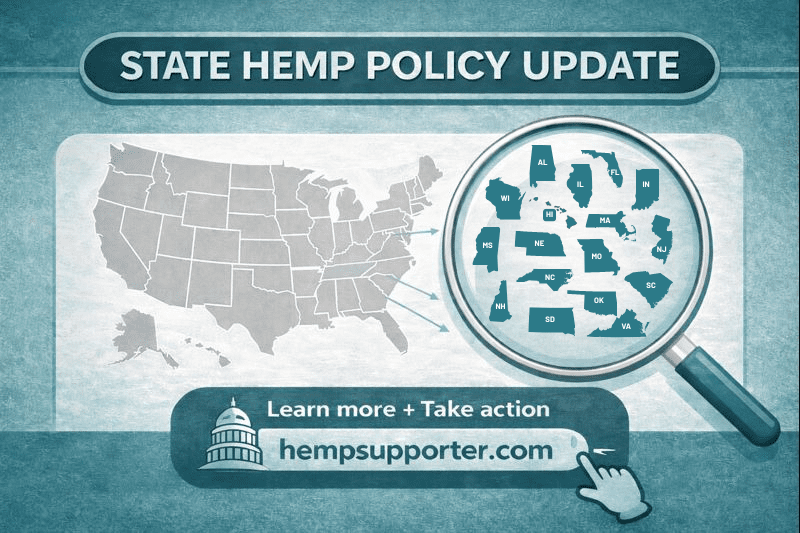
Take Action Now: Use our State Action Center to contact lawmakers and protect the future of hemp in your state.
We’re officially back with our state updates. for 2026. As state lawmakers across the country are considering legislation affecting hemp-derived products. Below is a state-by-state summary of key bills we are supporting, opposing, or monitoring, along with opportunities to engage where action is needed. Be sure to check back next week for updates on these bills and others, and as always, please share any bills you are hearing about across the states that aren’t mentioned here.
Alabama
SB 1 (Oppose)
Alabama SB 1 would reclassify psychoactive hemp-derived cannabinoids (delta 8/9/10, etc.) as controlled substances, effectively banning intoxicating hemp, confine CBD-type consumables to pharmacies only beginning January 1, 2026 (with Board of Pharmacy oversight), and limit lawful consumables to products made from Alabama-grown hemp.
Alabama residents:
Take Action: Contact state lawmakers to oppose SB 1
Florida
SB 1368, SB 1678, HB 1409, HB 801 (Monitoring)
Collectively, these measures move THC-infused beverages into alcohol-style control with 21+ purchasing, in-person sales at alcohol-licensed premises, local option restrictions, and bans on direct delivery. Definitions vary (capturing delta 8/9/10, HHC, THC-O, THC-P, etc.), but the through line is that hemp beverages are regulated within the alcohol ecosystem.
No action requested at this time. We will continue monitoring.
Hawaii
SB 2102 (Support)
Modernizes animal feed law to allow hemp-derived ingredients in pet, specialty pet, and horse feed beginning July 1, 2026 with registration, labeling, lawful sourcing, contaminant/THC limits, and GMP controls, while livestock feed awaits FDA/AAFCO approval.
Hawaii residents:
Take Action: Contact state lawmakers to support SB 2102
Illinois
Chicago City Council Ordinance (Monitoring)
The City Council approved a citywide ban on hemp-derived products with a limited carve-out for beverages sold only by liquor/packaged-goods licensees (reported vote 32–16), a local control trend to watch that funnels beverages into alcohol-licensed channels.
No action requested at this time. We will continue monitoring.
Indiana
SB 0250 (Oppose)
SB 0250 has passed the Indiana Senate by a vote of 35–13. This legislation creates a comprehensive regulatory framework for hemp-derived cannabinoid products, defining hemp as containing no more than 0.3% total tetrahydrocannabinols on a dry-weight basis. The bill also imposes a 0.4 milligram per-container cap on finished hemp-derived cannabinoid products and prohibits direct-to-consumer sales, including both online sales and delivery.
The bill has been referred to the House Committee on Courts and Criminal Code, where it will now be considered.
Indiana residents:
Take Action: Contact your state representatives and urge them to oppose SB 0250.
Massachusetts
S 2663 (Monitoring)
This, “Act to regulate hemp-derived beverages like alcohol” would establish a comprehensive system for manufacturing, distribution, sale, and taxation under an alcohol-style framework.
No action requested at this time. We will continue monitoring.
Mississippi
SB 2645 (Oppose)
Would impose a categorical ban on beverages containing hemp/THC, eliminating a controllable, age-gated format well suited to compliance.
Mississippi residents:
Take Action: Contact state lawmakers to oppose SB 2645
Missouri
HB 2765and SB 993 (Monitoring)
These bills establish a full three-tier system for hemp beverages under Alcohol & Tobacco Control, limit vertical integration, require hemp beverage retailers to hold alcohol licenses, and, under SB 993, impose a 7% excise tax plus consumer protections. HB 2765 includes a wholesaler residency requirement that could restrict market participation.
No action requested at this time. We will continue monitoring.
Nebraska
Executive Order on Synthetic THC (Monitoring)
Governor Jim Pillen, joined by Attorney General Mike Hilgers, signed an executive order addressing the illegal recreational synthetic THC industry. While framed as targeting synthetic products, review suggests it would actually ban any amount of THC in any hemp product.
No action requested at this time. We will continue monitoring.
New Hampshire
SB 485 and SB 624 (Oppose)
SB 485 creates an alcohol-style regime under the Liquor Commission, maintains a strict 0.3% THC dry-weight limit, bans direct-to-consumer shipping and delivery, and requires 21+ in-person sales at licensed retail only.
SB 624 restricts access to hemp-derived products with natural or synthetic THC above 0.3% dry weight and treats all THC isomers as THC. While age gating is appropriate, collapsing all isomers risks sweeping out compliant adult products.
New Hampshire residents:
Take Action: Contact state lawmakers to oppose SB 485 unless amended to remove the Direct-to-Consumer band and to also oppose SB 624.
New Jersey
S 1418 (Monitoring)
Creates a comprehensive framework for hemp-derived consumables and beverages, placing consumables with NJDA and beverages with ABC, repealing recent “intoxicating hemp” provisions, and focusing on delta 9 (0.3% dry weight) for consumables.
No action requested at this time. We will continue monitoring.
North Carolina
S 328 (Support)
Sets a 21+ minimum for ingestible and inhalable hemp-derived consumables, clearly defining covered products while excluding topicals and certain FDA-recognized safe seed ingredients. This has passed the Senate and House and only has a few more hurdles to overcome int he legislative process. Help us get it over the finish line!North Carolina residents:
Take Action: Contact state lawmakers to support SB 328
Oklahoma
SB 2092 (Monitoring)
Adds “hemp beverage” to the Alcoholic Beverage Control Act, gives the ABLE Commission clear oversight, and allows retail spirits licensees to sell hemp beverages. This bill has received its second reading in the Senate as of February 2nd.
No action requested at this time. We will continue monitoring.
South Carolina
HB 4759 (Oppose)
HB 4759 would allow THC beverages to be sold only through gas stations and liquor stores, while excluding other lawful retail channels. The bill limits products to 5 mg THC per container and imposes prohibitively expensive licensing fees, including:
- Manufacturer license: $50,000
- Wholesaler license: $20,000
- Retail dealer license: $1,200
The bill also includes excise taxes and restrictive provisions that would drive small businesses out of the market by favoring certain product forms over others.
HB 4758 (Oppose)
This bill would function as a near-total ban on consumable hemp products by prohibiting the retail sale or shipment into South Carolina of full spectrum hemp products. As written, HB 4758 would eliminate access to lawful hemp consumables for South Carolina consumers and effectively shut down much of the existing hemp market in the state.
South Carolina residents:
Take Action: Contact state lawmakers to oppose HB 4758 and HB 4759.
South Dakota
SB 61 (Oppose)
Would broadly prohibit non-medical hemp-derived intoxicants, sweeping in chemically converted cannabinoids and banning products synthesized outside the plant or containing more than 0.4 mg of any THC isomer per container; a near-total ban.
South Dakota residents:
Take Action: Contact state lawmakers to oppose SB 61.
Virginia
SB 543 (Oppose)
Would force hemp retailers into a punitive, marijuana-style licensing system with excessive fines and enforcement authority.
SB 142( Support)
Strengthens age verification and increases penalties for sales of tobacco and hemp smoking products to those under 21.
Virginia residents:
Take Action: Contact state lawmakers to oppose SB 543 and instead support SB 142.
Wisconsin
SB 499 and AB 503 (Monitoring)
Narrows “hemp” to total THC (including THCA) ≤0.3% dry weight, replacing delta 9-only references and removing flexibility if federal policy evolves.
SB 644 and AB 680 (Monitoring)
Defines “intoxicating hemp products” using thresholds that risk sweeping reasonable adult products into prohibition.
SB 681 and AB 606 (Monitoring)
Would build an alcohol-parallel regulatory system for hemp-derived cannabinoids.
SB682 and AB747 (Monitoring)
Establish strict regulations for the sale, labeling, testing, and packaging of hemp-derived cannabinoid products in Wisconsin, including age restrictions, product safety standards, and enforcement provisions. SB682 passed out of committee on February 3rd.
No action requested at this time. We will continue monitoring.

Visit our State Action Center to see active campaigns across the country!
Check out the latest hemp and CBD updates from across the states!
- State Hemp Policy Update: Delaware, Illinois, Nebraska, Nevada, Pennsylvania (Philadelphia), and Virginia
 Take Action Now: Use our State Action Center to contact lawmakers and protect the future of hemp in your state. As state lawmakers across the country are considering legislation affecting hemp-derived products. …
 - State Hemp Policy Update: Delaware, Illinois, Michigan, and Ohio.
 Take Action Now: Use our State Action Center to contact lawmakers and protect the future of hemp in your state. As state lawmakers across the country are considering legislation affecting hemp-derived products. …
 - State Hemp Policy Update: Delaware, Illinois, Nebraska, New Jersey, Pennsylvania (Philadelphia), and Virginia
 Take Action Now: Use our State Action Center to contact lawmakers and protect the future of hemp in your state. We’re officially back with our state updates. for 2026. As state lawmakers …