INDUSTRY UPDATES
February 24, 2026
State Hemp Policy Update: Georgia, Indiana, Kentucky, Michigan, Minnesota, Missouri, New Hampshire, Ohio, New Jersey, New York, Virginia, and Washington
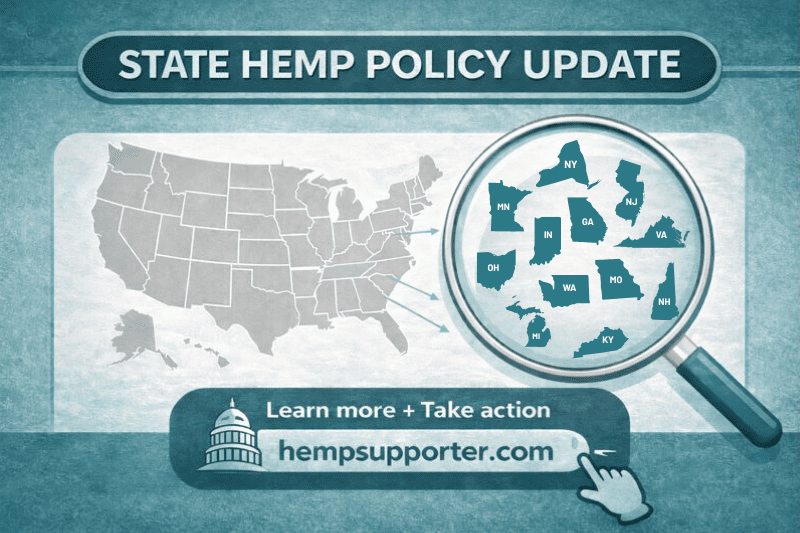
Take Action Now: Use our State Action Center to contact lawmakers and protect the future of hemp in your state.
We’re officially back with our state updates. for 2026. As state lawmakers across the country are considering legislation affecting hemp-derived products. Below is a state-by-state summary of key bills we are supporting, opposing, or monitoring, along with opportunities to engage where action is needed. Be sure to check back next week for updates on these bills and others, and as always, please share any bills you are hearing about across the states that aren’t mentioned here.
Georgia
SB 33 and SB 254 (Oppose)
SB 33 and SB 254 have been revived and would impose sweeping structural changes on Georgia’s lawful hemp marketplace. SB 33 attempts to mirror a proposed federal 0.4 mg THC per container standard, but as currently drafted its language would effectively prohibit nearly all hemp products in Georgia. SB 254 would require all consumable hemp products, regardless of form, to move into the state’s three-tier alcohol distribution system, dramatically disrupting the existing retail marketplace, potentially eliminating many current retailers, and restricting direct to consumer sales. Georgia already operates under a robust hemp regulatory framework and is actively expanding access to medical cannabis. Rather than replacing practical regulation with exclusionary market structures that function as de facto bans, lawmakers should focus on targeted enforcement, reasonable oversight, and balanced, science-based policy that protects consumers while preserving lawful businesses.
Georgia residents – Take Action: Contact your State Senators and respectfully urge them to oppose SB 33 and SB 254.
Indiana
SB 250 (Dead)
Thanks to the strong advocacy efforts of the Midwest Hemp Council and industry partners across Indiana, SB 250 was not called down from the Second Reading calendar yesterday and is now effectively dead for this legislative session.
As a reminder, SB 250 would have created a comprehensive regulatory framework for hemp-derived cannabinoid products, defining hemp as containing no more than 0.3% total tetrahydrocannabinols on a dry-weight basis. The bill would also have imposed a 0.4 milligram per-container cap on finished hemp-derived cannabinoid products and prohibitied direct-to-consumer sales, including both online sales and delivery.
We will continue monitoring developments closely and will alert you if similar language is reintroduced in another bill before the session adjourns on February 27.
Kentucky
SB 223 (Support) | HB 612 (Oppose Unless Amended)
Yesterday, Kentucky lawmakers introduced SB 223, legislation that would create lawful retail and distribution opportunities for cannabis-infused beverages by integrating these products into the state’s existing alcohol regulatory framework. The bill authorizes supplemental licenses allowing qualified retailers, including hemp retail establishments, to sell cannabis-infused beverages and establishes a clear, workable regulatory pathway under the Department of Alcoholic Beverage Control.
This stands in contrast to HB 612, which we previously alerted you to. As written, HB 612 would impose a potency-based tax of $0.16 per milligram of THC on hemp-derived cannabinoid products beginning July 1, 2027. At this rate, the tax would dramatically increase consumer costs and function as a prohibition-level tax on compliant hemp products. The bill also establishes new licensing fees, enforcement penalties, and liability provisions that would significantly increase the regulatory burden on hemp retailers and restrict market participation.
Together, these bills represent two very different approaches. SB 223 creates a lawful and sustainable regulatory pathway that allows hemp businesses to participate in a licensed marketplace, while HB 612, unless amended, would impose excessive taxation that threatens the viability of Kentucky’s hemp industry.
Kentucky Residents – Take Action: Contact your legislators and urge them to vote NO on HB 612 unless it is amended, and instead support SB 223 to create a fair, workable regulatory framework for hemp-derived products.
Michigan
HB 599 (Monitoring)
HB 599, which would establish a regulatory framework governing hemp-derived cannabinoid products, has not seen legislative movement since December 2025. However, we have received recent inquiries about the status of hemp legislation in Michigan and will continue monitoring the bill closely. We will share updates as legislative activity resumes or new developments emerge.
No action requested at this time. We will continue monitoring.
Minnesota
SF 3591 (Monitoring)
A new bill in Minnesota, SF 3591 was introduced on February 17, 2026, and would establish regulatory provisions governing hemp-derived cannabinoid products, including product standards, licensing, and compliance requirements. The bill is in the early stages of the legislative process.
No action requested at this time. We will continue monitoring.
Missouri
HB 2641 (Oppose)
HB 2641 would reclassify hemp-derived cannabinoid products as marijuana under Missouri law, limiting legal production, distribution, and sales to businesses licensed under the state’s existing marijuana regulatory system. This would require hemp-derived products to be sold exclusively through marijuana license holders and would prohibit current hemp businesses that are not licensed within that system from continuing to operate in the marketplace. The bill would significantly restructure Missouri’s hemp industry by shifting regulatory authority and restricting participation to licensed marijuana operators.
Missouri residents – Take Action: Contactyour State Senators and respectfully urge them to oppose HB 2641.
New Hampshire
SB 624 (Oppose)
We previously reported on this bill. As originally written, SB 624 would have restricted access to hemp-derived products with natural or synthetic THC above 0.3% dry weight and treats all THC isomers as THC. While age gating is appropriate, collapsing all isomers risks sweeping out compliant adult products. Worse, a recent committee amendment would further restrict lawful products by establishing a 0.4 milligram THC per container limit, replacing the existing dry-weight standard. The bill was reported out of committee with the amendment and will now advance in the legislative process.
New Hampshire residents – Take Action: Contact state lawmakers and respectfully urge them to oppose SB 624.
New Jersey
A4082 (Monitoring)
A4082 would establish a regulatory framework for hemp-derived cannabinoid products that maintains the 0.3% total THC dry-weight standard and preserves retail and e-commerce sales channels. This is a carry over bill from last year similar to S2537, S1699, and A1890. The new bill requires registration for processors and retailers, establishes a 21+ age restriction, and provides statewide standards for labeling, packaging, and compliance. It also authorizes regulated on-farm minimally processed hemp products and preempts local governments from adopting conflicting regulations. The bill reflects a structured statewide approach to regulating hemp-derived cannabinoid products.
No action requested at this time. We will continue monitoring.
New York
A10191 (Monitoring)
A10191 would allow liquor and wine stores to sell low-dose cannabis beverages produced by New York adult-use licensees. The bill establishes a 5mg total THC per container limit, requires beverages to be sold in a separate designated sales area, and mandates participation in an Office of Cannabis Management (OCM) approved tracking system. The bill also imposes a 9% tax at the distribution level and a 13% tax at retail.
No action requested at this time. We will continue monitoring.
Ohio
The clock is ticking in Ohio as the deadline for signatures approaches. If successful, the citizen-led referendum would stay enforcement of SB56, allowing for the continued sale of hemp-derived products in Ohio, including direct-to-consumer sales, until voters can weigh in as part of a ballot initiative in the state.
Ohio residents: Sign the petition and donate to support the effort. https://noonsb56.com/
Non-Ohio residents: Donate to support the efforts and share with your friends or customers in Ohio. https://noonsb56.com/
Virginia
SB 543 (Oppose)
We previously reported on this bad bill in Virginia. SB 543 would establish a marijuana-style licensing and enforcement structure for hemp retailers, including expanded regulatory authority and penalties. The bill has passed its original chamber in and now heads to the House for consideration.
Virginia residents – Take Action: Contact state lawmakers to oppose SB 543.

Visit our State Action Center to see active campaigns across the country!
Check out the latest hemp and CBD updates from across the states!
- State Hemp Policy Update: Georgia, Indiana, Kentucky, Michigan, Minnesota, Missouri, New Hampshire, Ohio, New Jersey, New York, Virginia, and Washington
 Take Action Now: Use our State Action Center to contact lawmakers and protect the future of hemp in your state. We’re officially back with our state updates. for 2026. As state lawmakers …
 - State Hemp Policy Update: Farm Bill, Illinois, Kentucky, Minnesota, New Jersey, Ohio, South Carolina, South DakotaTake Action Now: Use our State Action Center to contact lawmakers and protect the future of hemp in your state. We’re officially back with our state updates. for 2026. As state lawmakers …
- State Hemp Policy Update: Alabama, Florida, Hawaii, Illinois, Indiana, Massachusetts, Mississippi, Missouri, Nebraska, New Hampshire, New Jersey, North Carolina, Oklahoma, South Carolina, South Dakota, Virginia, and WisconsinTake Action Now: Use our State Action Center to contact lawmakers and protect the future of hemp in your state. We’re officially back with our state updates. for 2026. As state …