INDUSTRY UPDATES
May 05, 2026
State Hemp Policy Update: Colorado, Connecticut, Oklahoma, South Carolina
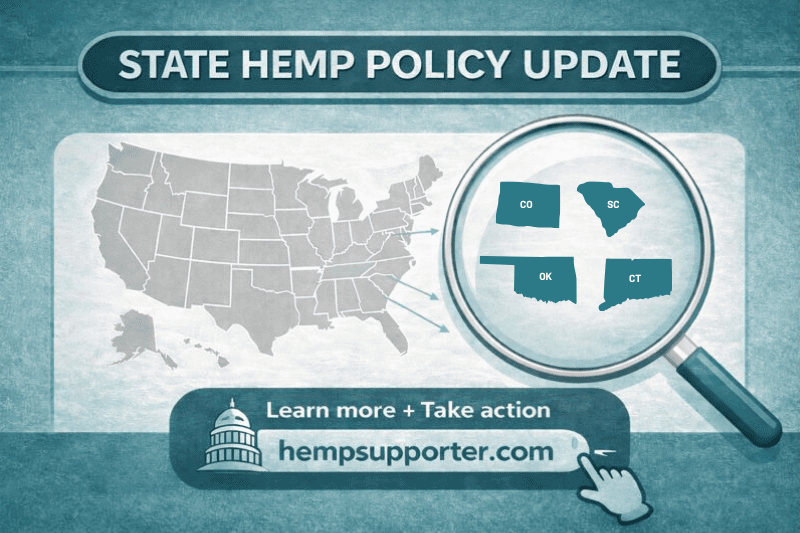
Take Action Now: Use our State Action Center to contact lawmakers and protect the future of hemp in your state.
As state lawmakers across the country are considering legislation affecting hemp-derived products. Below is a state-by-state summary of key bills we are supporting, opposing, or monitoring, along with opportunities to engage where action is needed. Be sure to check back next week for updates on these bills and others, and as always, please share any bills you are hearing about across the states that aren’t mentioned here.
Colorado
S.B. 26-164 (Dead)
We are hearing from reliable sources on the ground that S.B. 26-164 is no longer advancing and is effectively considered dead for this session. While disappointing, we will continue to monitor developments closely and advocate for similar regulatory frameworks in Colorado moving forward.
As a reminder, S.B. 26-164 would have established a clear regulatory framework for hemp-derived THC beverages in Colorado by defining lawful THC beverages as nonalcoholic hemp products containing up to 10 milligrams of THC per serving and creating a regulated pathway for these products to be sold through traditional retail and hospitality channels.
This legislation reflected the type of thoughtful regulatory model the U.S. Hemp Roundtable has encouraged states to adopt. Rather than pursuing prohibition, Colorado was working to create clear, enforceable standards that preserve consumer access while supporting businesses operating in compliance with the law.
Connecticut
H.B. 5350 (Monitoring)
HB 5350 has now passed the second chamber and continues to move forward in the legislative process.
The legislation would restructure the state’s cannabis and hemp framework by redefining “cannabis” to include high-THC hemp products, while expressly excluding compliant hemp (≤ 0.3% total THC), infused beverages, and certain qualifying commercial extracts.
As a reminder, the bill would increase THC limits for infused beverages to 5 mg per container in liquor-licensed channels and 10 mg per container at cannabis retailers, establish a definition for high-THC beverages, and restrict those higher-potency beverages to out-of-state sales. It also creates a comprehensive regulatory structure for infused beverages, including licensing, testing, labeling, distribution requirements, age verification, fees, and on-premises consumption endorsements.
No action requested at this time. We will continue monitoring.
Oklahoma
S.B. 3 (Oppose)
As we reported on Friday, Oklahoma’s hemp industry is facing an existential threat, and the U.S. Hemp Roundtable is calling on Oklahoma residents to take action and make your voice heard. S.B. 3, currently being reviewed to send to conference committee, would adopt a federal-style total THC limit based on a 0.4 mg per-container standard. This would effectively ban an estimated 95% of compliant hemp products currently on the market, eliminating jobs, closing businesses, and harming the Oklahoma farmers and retailers who depend on this industry.
The U.S. Hemp Roundtable supports strong, science-based hemp regulation, such as that proposed in H.B. 4248, but S.B. 3 goes too far.
Oklahoma Residents: Take Action Contact your State Senators and ask that Senate leadership NOT advance S.B. 3 further due to the harm it would cause farmers and small businesses. The future of hemp in Oklahoma rests with key decision makers on this bill, Senators Paxton, Coleman, and Green, and we need them to hear your voice.
South Carolina
South Carolina has reached a critical final stage, with lawmakers actively negotiating hemp legislation that could be finalized within days. The issue (previously reported) is currently in a conference committee, and once an agreement is reached, it will move quickly for final approval- leaving very limited time for changes.
As currently being discussed, proposals under consideration could severely restrict the sale of hemp-derived products by limiting allowable product categories, restricting where products can be sold, and imposing new licensing and operational requirements on existing businesses. Some approaches being considered would effectively eliminate large portions of the current marketplace, including many products consumers rely on for wellness, while shifting remaining sales into tightly controlled channels.
These types of frameworks risk forcing existing hemp retailers to dramatically alter their business models, take on costly new requirements, or shut down altogether. They could also reduce consumer access to regulated, tested products and eliminate common retail pathways such as direct-to-consumer sales.
South Carolina has an opportunity to implement thoughtful, science-based regulation that protects consumers without dismantling the existing marketplace—but time is running out to influence the outcome.
South Carolina Residents – Take Action: Contact your state lawmakers immediately and urge them to oppose overly restrictive hemp legislation and instead support a balanced, workable regulatory framework that preserves access, protects consumers, and supports local businesses

Visit our State Action Center to see active campaigns across the country!
Check out the latest hemp and CBD updates from across the states!
- State Hemp Policy Update: Delaware, Illinois, Nebraska, Nevada, Pennsylvania (Philadelphia), and Virginia
 Take Action Now: Use our State Action Center to contact lawmakers and protect the future of hemp in your state. As state lawmakers across the country are considering legislation affecting hemp-derived products. …
 - State Hemp Policy Update: Delaware, Illinois, Michigan, and Ohio.Take Action Now: Use our State Action Center to contact lawmakers and protect the future of hemp in your state. As state lawmakers across the country are considering legislation affecting hemp-derived products. …
- State Hemp Policy Update: Delaware, Illinois, Nebraska, New Jersey, Pennsylvania (Philadelphia), and VirginiaTake Action Now: Use our State Action Center to contact lawmakers and protect the future of hemp in your state. We’re officially back with our state updates. for 2026. As state lawmakers …