INDUSTRY UPDATES
March 30, 2026
State Hemp Policy Update: Kentucky, Maryland, Ohio, South Carolina, and Texas
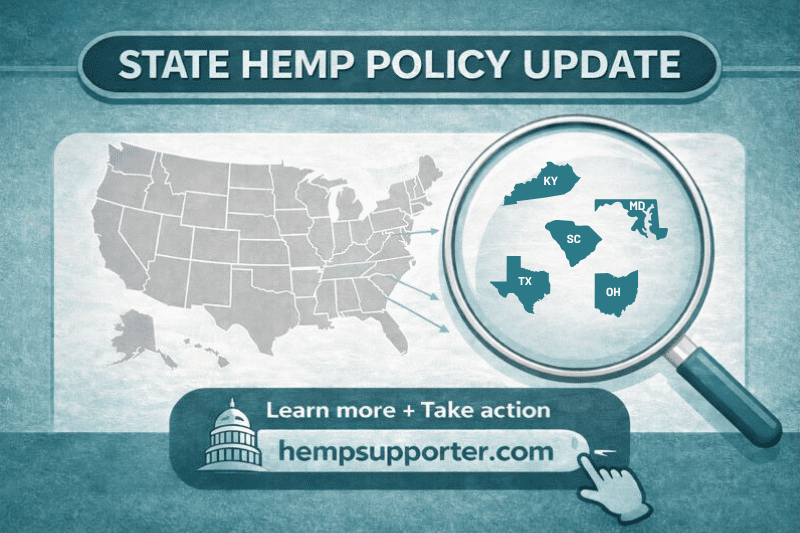
Take Action Now: Use our State Action Center to contact lawmakers and protect the future of hemp in your state.
As state lawmakers across the country are considering legislation affecting hemp-derived products. Below is a state-by-state summary of key bills we are supporting, opposing, or monitoring, along with opportunities to engage where action is needed. Be sure to check back next week for updates on these bills and others, and as always, please share any bills you are hearing about across the states that aren’t mentioned here.
Kentucky
SB 223 (Support)
Kentucky lawmakers have introduced two different approaches to regulating hemp-derived products.
As we have been reporting, SB 223 would create lawful retail and distribution opportunities for cannabis-infused beverages by integrating these products into the state’s existing alcohol regulatory framework.
The bill would:
- Authorize supplemental licenses allowing qualified retailers, including hemp retail establishments, to sell cannabis-infused beverages
- Establish a clear regulatory pathway under the Department of Alcoholic Beverage Control
- Prohibit open containers of THC beverages in motor vehicles, an important safeguard for responsible regulation
While SB 223 previously advanced out of the Senate, recent developments indicate the bill is not expected to move forward in the House at this time.
Despite this, the need for a clear and workable regulatory pathway for hemp-derived beverages remains. As neighboring states adopt more restrictive policies, Kentucky continues to be a key market for hemp businesses, including those shifting operations or product into the state.
Kentucky Residents – Stay Engaged: Use this form to continue engaging with lawmakers and sharing the importance of establishing a fair, workable framework for hemp-derived products in Kentucky.
Maryland
SB 994 (Monitor)
Maryland lawmakers have introduced SB 994, legislation that would establish a hemp manufacturing license under the Department of Agriculture. The bill appears limited in scope at this stage, but it does create a new licensing structure and delegates significant authority to the Department to define regulatory requirements. Regulations would be required by October 1, 2026, with the bill set to take effect September 1, if enacted.
While currently in the Rules Committee, it may advance given its sponsorship. At this stage, the bill contains several undefined elements that could have broader implications depending on how regulations are ultimately structured.
No action requested at this time. We will continue monitoring.
Ohio
SB 56
As we have been reporting, Ohio’s hemp market is now facing immediate disruption following Governor DeWine’s veto of hemp beverage provisions included in SB 56.
As enacted, SB 56 imposes strict THC limits across all hemp products, including beverages, removing prior allowances that would have permitted hemp beverages containing up to 5 mg THC to remain on the market through the end of 2026. The result is a de facto ban on the vast majority of hemp-derived products currently sold in Ohio.
The real-world impact is already underway. Companies are actively moving product out of Ohio and into neighboring states, including Kentucky, in order to continue lawful sales. This is resulting in lost economic activity, displaced inventory, and immediate harm to Ohio businesses.
There is ongoing discussion of a potential legislative veto override, which would require a three-fifths vote in both chambers. While the likelihood of success remains uncertain, stakeholders are working to demonstrate public support.
Ohio Residents – Take Action: Visit the link below to help support efforts to override the Governor’s veto and restore a workable pathway for hemp products in Ohio:
https://www.saveohiobevs.com/
South Carolina
H.3924 (Oppose as Written)
We’ve been monitoring South Carolina, and we have reached a critical stage as H.3924 has been returned to the House for final consideration following Senate action.
As advanced, the bill would significantly restrict the hemp market by permitting only limited product categories. Specifically, it would allow low-dose hemp beverages through traditional alcohol channels and permit 10 mg THC beverages and packages of four 10 mg THC gummies to be sold exclusively through licensed liquor stores. All other full-spectrum hemp products would be prohibited.
Under this framework, existing hemp retailers would be required to obtain liquor licenses, secure appropriate insurance, and comply with zoning requirements in order to remain operational. Even if able to meet these requirements, businesses would be limited to selling only the permitted intoxicating products, effectively eliminating the ability to offer non-intoxicating wellness items such as tinctures, topicals, creams, and similar products. Direct-to-consumer sales would also be prohibited.
The practical effect would be a significant contraction of South Carolina’s hemp market, including the loss of existing retail operations and reduced consumer access to regulated products.
During Senate consideration, multiple lawmakers raised concerns about the bill’s impact on small businesses and its inconsistency with prior commitments to avoid disrupting the existing marketplace.
The bill is now back in the House for final reading, which could occur in the coming days.
South Carolina Residents – Take Action: Contact all House members and urge them to oppose H.3924 as currently written and pursue a more balanced, workable regulatory framework for hemp products.
Texas
Consumable Hemp Rules (Monitor / Oppose Burdensome Implementation)
Texas has adopted major new consumable hemp rules through DSHS, with the rules filed on March 2 and taking effect on March 31, 2026. The adopted rules raise licensing fees for manufacturers to $10,000 per facility and retailer registration fees to $5,000 per location, add THCA into the total-THC framework, and impose expanded testing, packaging, labeling, and recordkeeping requirements.
The new labeling rules also require a conspicuously marked URL linking directly to a certificate of analysis for the product or each hemp-derived ingredient, and that link must reach the required COA in three or fewer steps. Recent reporting has also highlighted concerns that the new rules will eliminate smokeable hemp products and create significant compliance burdens for smaller businesses.
US Hemp Roundtable supports clear rules that protect minors and improve consumer transparency. At the same time, steep fee increases and overly burdensome regulatory requirements can function as market exclusion measures for small businesses rather than reasonable public-health safeguards.

Visit our State Action Center to see active campaigns across the country!
Check out the latest hemp and CBD updates from across the states!
- State Hemp Policy Update: Delaware, Illinois, Nebraska, Nevada, Pennsylvania (Philadelphia), and Virginia
 Take Action Now: Use our State Action Center to contact lawmakers and protect the future of hemp in your state. As state lawmakers across the country are considering legislation affecting hemp-derived products. …
 - State Hemp Policy Update: Delaware, Illinois, Michigan, and Ohio.
 Take Action Now: Use our State Action Center to contact lawmakers and protect the future of hemp in your state. As state lawmakers across the country are considering legislation affecting hemp-derived products. …
 - State Hemp Policy Update: Delaware, Illinois, Nebraska, New Jersey, Pennsylvania (Philadelphia), and Virginia
 Take Action Now: Use our State Action Center to contact lawmakers and protect the future of hemp in your state. We’re officially back with our state updates. for 2026. As state lawmakers …