INDUSTRY UPDATES
May 27, 2026
State Hemp Policy Update: Delaware, Illinois, Nebraska, New Jersey, Pennsylvania (Philadelphia), and Virginia
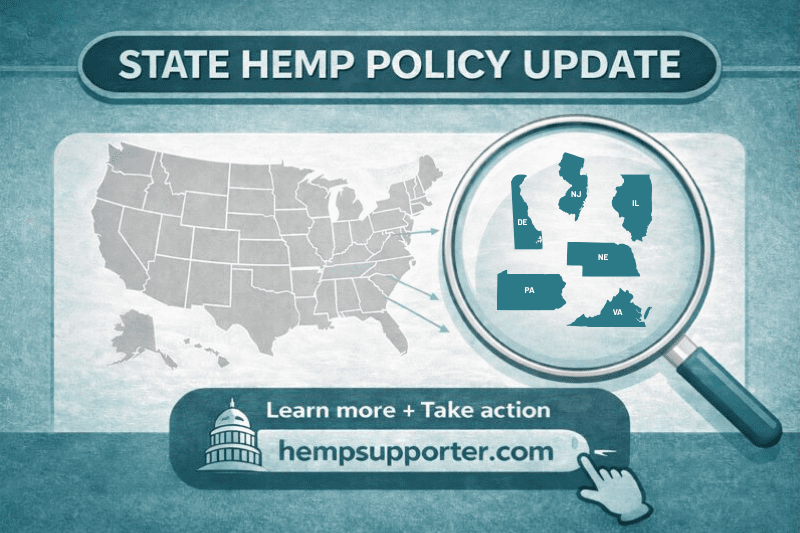
Take Action Now: Use our State Action Center to contact lawmakers and protect the future of hemp in your state.
We’re officially back with our state updates. for 2026. As state lawmakers across the country are considering legislation affecting hemp-derived products. Below is a state-by-state summary of key bills we are supporting, opposing, or monitoring, along with opportunities to engage where action is needed. Be sure to check back next week for updates on these bills and others, and as always, please share any bills you are hearing about across the states that aren’t mentioned here.
Delaware
HB 395 (Oppose)
We flagged this bad bill last week, but now HB 395 has advanced out of committee in Delaware and continues to move through the legislative process.
As previously reported, the legislation would significantly restructure the State’s hemp framework by effectively treating many hemp-derived cannabinoid products as marijuana products, mirroring key concepts contained in the pending federal hemp ban language.
The bill establishes a threshold for “total THC” content, including:
- 0.4 milligrams of total THC per container for products that would otherwise be classified as marijuana products. This would effectively ban 95% of all hemp products on the marketplace.
- 0.3% total THC for industrial hemp, and
The legislation also specifies which cannabinoids are considered non-intoxicating and introduces the concept of “counterfeit THC ingredients,” defined as cannabinoids not naturally produced by the cannabis plant or cannabinoids synthesized artificially. Products containing those ingredients intended for human or animal consumption would be prohibited. If enacted, the legislation could substantially restrict the existing hemp marketplace in Delaware, including many federally lawful hemp-derived cannabinoid products currently sold through traditional retail channels.
Delaware residents: Take Action: Contact state lawmakers and urge them to oppose legislation that would effectively prohibit much of the existing hemp marketplace through overly restrictive THC limits and product classifications.
Illinois
HB5784 / SB 20 (Oppose)
Illinois lawmakers have introduced HB578 in the House and SB20 in the Senate, that would both significantly restrict the state’s hemp market.
Both bills would impose a strict 0.4 milligram per container cap on total THC and other cannabinoids deemed to have similar effects to THC- effectively banning 95% of products in the hemp marketplace. Products exceeding that threshold would no longer qualify as lawful hemp and instead could only be sold through licensed cannabis dispensaries.
The legislation would also exclude many existing hemp-derived cannabinoid products from the legal definition of hemp, create extensive registration and compliance requirements for retailers and manufacturers, and establish broad enforcement authority over the marketplace.
Illinois Residents: Take Action: Contact state lawmakers and urge them to oppose HB5784 and SB20 as written. Illinois should pursue a balanced regulatory framework that protects consumers through reasonable safeguards without effectively eliminating much of the existing hemp marketplace through overly restrictive THC limits and product classifications.
Nebraska
Proposed Adulterated Food Product Regulations (Monitoring)
The Nebraska Department of Agriculture has issued a Notice of Rulemaking Hearing regarding proposed “Adulterated Food Product Regulations” under the Nebraska Pure Food Act.
According to the notice, the proposed regulations would establish standards for determining when food products are considered adulterated or misbranded and would provide that food products containing, or labeled to contain, tetrahydrocannabinols may be deemed adulterated or misbranded under state law. The notice specifically references products marketed as gummies, drops, and beverages, including certain synthetic THC products intended to produce psychoactive effects similar to Delta-9 THC.
The rulemaking hearing is scheduled for June 18, 2026, at 10:00 a.m. CT at the LL Hearing Room, 245 Fallbrook Blvd, Lincoln, Nebraska 68521.
Interested parties may submit written comments to the Nebraska Department of Agriculture by June 17, 2026, by mail to PO Box 94947, 245 Fallbrook Blvd Ste 200, Lincoln, Nebraska 68521 or by email to [email protected].
No action requested at this time. We will continue monitoring the proposed regulations and share details as we know more.
New Jersey
A5051 / S4297 (Monitoring)
As we shared last week, New Jersey currently maintains one of the more restrictive hemp frameworks in the country. Under existing law, many hemp-derived cannabinoid products are prohibited, including products containing certain synthesized cannabinoids and final hemp-derived cannabinoid products containing more than 0.4 milligrams of total THC per container. Current law also permits intoxicating hemp beverages to continue being sold through certain licensed alcohol and cannabis businesses until November 13, 2026, subject to serving size, testing, labeling, and retail restrictions.
A5051 has now passed the House, and companion legislation, S4297, has been introduced in the Senate. The legislation would revise portions of New Jersey’s existing framework rather than establish an entirely new system.
As a reminder, the legislation would:
- extend certain May 31, 2026 implementation deadlines related to hemp processing and intoxicating hemp beverages until November 13, 2026,
- revise permitted container formats for intoxicating hemp beverages by allowing:
- cans containing up to 5 milligrams of THC per serving and 10 milligrams per container, and
- resealable 750 mL bottles containing up to 40 servings of 5 milligrams each, or 200 milligrams total THC per bottle,
- remove certain requirements that intoxicating hemp beverages be stored behind counters or otherwise inaccessible to consumers,
- allow licensed alcohol establishments to display intoxicating hemp beverages in customer-accessible areas if certain monitoring, signage, and age-verification requirements are met,
- require customers purchasing intoxicating hemp beverages to be informed of appropriate serving sizes,
- allow a 10 percent variance in laboratory testing results for cannabinoid concentrations,
- and expand the ability of certain alcohol license holders to sell intoxicating hemp beverages for off-premises consumption.
The legislation maintains New Jersey’s existing restrictions on many non-beverage hemp-derived cannabinoid products, including the State’s current THC limits applicable to those products.
New Jersey Residents: Take Action: Contact state lawmakers and urge them to support A5051 / S4297 and the reasonable improvements the legislation makes to the hemp beverage framework. At the same time, urge lawmakers to continue pursuing broader, science-based regulatory pathways for all hemp-derived cannabinoid products rather than maintaining overly restrictive THC limits and product classifications that effectively prohibit much of the existing hemp marketplace.
Pennsylvania (Philadelphia)
City Ordinance – Bill No. 260163 (Oppose)
Philadelphia City Council is considering Bill No. 260163, an ordinance that would establish a new regulatory framework governing “intoxicating substances,” including hemp-derived cannabinoid products and kratom products.
Most notably, the ordinance would prohibit the sale of final hemp-derived cannabinoid products containing more than 0.4 milligrams per container of total tetrahydrocannabinols and similar-effect cannabinoids. This per-container standard closely mirrors restrictive policy language currently being debated at the federal level and would effectively ban 95% of all hemp products on the marketplace.
In addition to the 0.4 milligram per container restriction, the ordinance would:
- prohibit certain cannabinoids that are not naturally produced by cannabis or are synthesized outside the plant;
- prohibit the direct-to-consumer sale of intermediate hemp-derived cannabinoid products;
- restrict sales of intoxicating substances, including hemp products, to individuals 21 years of age or older;
- require retailers to obtain an “Intoxicating Substance Retailer” license for each retail location;
- impose extensive zoning and location restrictions on retailers;
- establish testing requirements for THC concentration, contaminants, heavy metals, pesticides, solvents, mycotoxins, and microbial impurities; and
- establish labeling requirements and civil penalties for violations.
While the ordinance is framed as a public safety measure, the proposed 0.4 milligram per container standard would severely disrupt the existing hemp marketplace and could effectively eliminate many federally lawful hemp products currently sold by Philadelphia businesses. The bill was referred out of committee and will now be considered by the full council.
Philadelphia residents: Take Action: Contact Philadelphia City Council members and urge opposition to Bill No. 260163. Ask council members to support responsible, science-based regulation of hemp-derived products, not arbitrary restrictions that effectively prohibit the industry.
Specifically, urge councilmembers to support:
- strong age restrictions for adult-use products;
- robust testing, labeling, and packaging requirements;
- reasonable serving-size limits based on science and consumer safety;
- safeguards to keep products away from minors; and
- enforcement against bad actors and unsafe products.
At the same time, urge them to oppose:
- arbitrary 0.4 milligram per container THC limits that would ban 95% of all hemp products on the marketplace;
- regulations that effectively ban federally lawful hemp products;
- unnecessary barriers that would eliminate small businesses and consumer access; and
- policies that push compliant hemp products out of traditional retail channels.
Philadelphia residents can find their councilmembers here: Philadelphia City Council Member Directory
Virginia
HB 2485 (Monitoring)
Virginia Governor Abigail Spanberger has vetoed SB 542/HB 642 , legislation that would have established a regulated adult-use marijuana retail marketplace in the Commonwealth.
While the legislation primarily focused on marijuana regulation rather than hemp-specific policy, the proposal had been closely watched by stakeholders across the hemp and cannabis industries due to the potential downstream impacts on intoxicating hemp products, retail structures, and future regulatory discussions in Virginia.
Governor Spanberger stated that concerns related to public safety, impaired driving, youth access, and broader implementation issues contributed to the decision to veto the legislation.
At this time, no direct changes to Virginia’s existing hemp framework have resulted from the veto. However, hemp policy discussions in the Commonwealth are expected to continue as lawmakers evaluate future approaches to intoxicating cannabinoid regulation and broader cannabis policy issues.
Statement from Jonathan Miller, general counsel of the U.S. Hemp Roundtable, on Governor Abigail Spanberger’s veto today of the bill that would have established a retail cannabis market in Virginia:
“The U.S. Hemp Roundtable asked Governor Spanberger to veto this legislation because the bill imposed sweeping new restrictions on legal hemp products that Virginia consumers and farmers rely upon. We thank the governor for protecting access to hemp products in Virginia, but this puts us in a difficult position.
The US Hemp Roundtable supports the efforts of Delegate Paul Krizek and Senator Lashrecse Aird to legalize the adult-use marijuana market in Virginia, but the bill that reached the governor’s desk did not give us the ability to support that effort without sacrificing Virginia’s lawful hemp industry in the process. We will not apologize for defending low-dose hemp products, but we do not enjoy being seen as being against the efforts to legalize adult-use marijuana.
In the 2027 session, we hope stakeholders in Virginia can craft legislation that establishes a regulated retail cannabis market without restricting the hemp products that meet federal standards, like those established by the Centers for Medicare and Medicaid Services for orally administered, non-inhalable low-dose hemp supplements.”

Visit our State Action Center to see active campaigns across the country!
Check out the latest hemp and CBD updates from across the states!
- State Hemp Policy Update: Delaware, Illinois, Nebraska, Nevada, Pennsylvania (Philadelphia), and Virginia
 Take Action Now: Use our State Action Center to contact lawmakers and protect the future of hemp in your state. As state lawmakers across the country are considering legislation affecting hemp-derived products. …
 - State Hemp Policy Update: Delaware, Illinois, Michigan, and Ohio.
 Take Action Now: Use our State Action Center to contact lawmakers and protect the future of hemp in your state. As state lawmakers across the country are considering legislation affecting hemp-derived products. …
 - State Hemp Policy Update: Delaware, Illinois, Nebraska, New Jersey, Pennsylvania (Philadelphia), and Virginia
 Take Action Now: Use our State Action Center to contact lawmakers and protect the future of hemp in your state. We’re officially back with our state updates. for 2026. As state lawmakers …