INDUSTRY UPDATES
June 16, 2026
State Hemp Policy Update: Delaware, Illinois, Michigan, and Ohio.
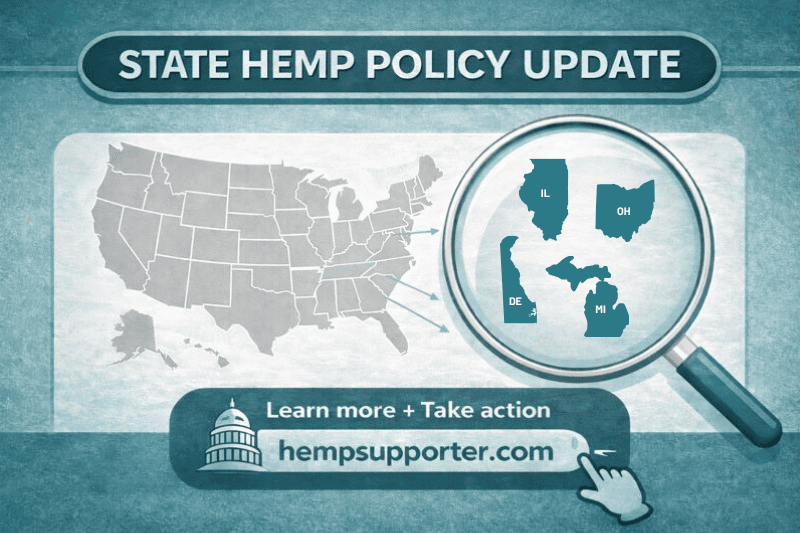
Take Action Now: Use our State Action Center to contact lawmakers and protect the future of hemp in your state.
As state lawmakers across the country are considering legislation affecting hemp-derived products. Below is a state-by-state summary of key bills we are supporting, opposing, or monitoring, along with opportunities to engage where action is needed. Be sure to check back next week for updates on these bills and others, and as always, please share any bills you are hearing about across the states that aren’t mentioned here.
Delaware
HB 373 / HB 395 (Oppose)
We’ve been keeping you updated on the latest here, and we need Delaware supporters to act AS SOON AS POSSIBLE. Both bad bills in Delaware are listed on the Delaware House agenda for today, Tuesday, June 16, meaning lawmakers could vote on them as soon as today.
HB 373 would unnecessarily limit market access and harm existing businesses. The bill sets forth a new framework for THC-infused beverages, including manufacturing standards, authorization requirements, taxation, and restrictions on how and where those beverages may be sold.
While the bill allows beverages containing up to 10 milligrams of Delta-9 THC per container and includes reasonable product testing, labeling, and youth access safeguards, it restricts sales to package stores and marijuana retailers while imposing new taxes, licensing fees, and operational burdens on businesses. Delaware should not create a system that unnecessarily limits consumer access and shuts out broader retail participation.
HB 395 is a prohibition bill that would effectively classify many hemp-derived cannabinoid products as marijuana products by applying a 0.4 milligram total THC per container threshold.
The bill also specifies which cannabinoids are considered non-intoxicating and introduces the concept of “counterfeit THC ingredients,” defined as cannabinoids not naturally produced by the cannabis plant or those synthesized artificially, with restrictions on their inclusion in products intended for human or animal consumption. If enacted, the legislation would wipe out over 95% of the existing hemp marketplace in Delaware.
Delaware Residents: Take Action: Contact state lawmakers and urge them to vote NO on HB 373 and HB 395.
*The Delaware session is currently scheduled to adjourn on June 30th, 2026.
Illinois
S 3222 (Oppose)
In unfortunate news from last month, Illinois lawmakers officially S3222 (Formerly HB5784 / SB 20) to significantly restrict the state’s hemp market. The bill was signed into law and officially repeals the Current Hemp Act on November 12th, 2026.
The new law will impose a strict 0.4 milligram per container cap on total THC and other cannabinoids deemed to have similar effects to THC- effectively banning 95% of products in the hemp marketplace. Products exceeding that threshold would no longer qualify as lawful hemp and instead could only be sold through licensed cannabis dispensaries.
The legislation also excludes many existing hemp-derived cannabinoid products from the legal definition of hemp, creates extensive registration and compliance requirements for retailers and manufacturers, and establishes broad enforcement authority over the marketplace.
Michigan
HB 5040 / HB 5041 / HB 5042 / HB 5043 (Monitoring)
Michigan stakeholders anticipate a House Regulatory Reform Committee hearing on a series of hemp bills this week.
Most notably, HB 5040 would define “nonintoxicating cannabinoids” to include full spectrum industrial hemp extract only if it contains no more than 1.75 milligrams of THC per serving and a cannabidiol-to-THC ratio of greater than or equal to 15:1. That means products exceeding that threshold would fall outside the bill’s nonintoxicating category, raising serious concerns for a broad range of CBD products currently on the market. This would constitute a ban on most hemp beverages.
HB 5040 would also create a new regulatory framework for “consumable hemp products,” including licensing requirements for processors, product sampling and testing, labeling requirements, fees, rulemaking authority, and civil sanctions and penalties. The bill’s labeling provisions would require, among other things, warning statements in bold capital letters, ingredient listings, net weight, and disclosure of the percentage of nonintoxicating cannabinoids by weight.
The bill further classifies a wide range of cannabinoids as “intoxicating cannabinoids,” including delta-9, delta-8, delta-7, delta-10, certain THC metabolites, hydrogenated forms of THC, synthetic forms of THC, ester forms of THC, and other cannabinoids designated by rule. It also creates a separate category for “potentially intoxicating cannabinoids.”
The related clean-up bills would make conforming changes if HB 5040 is enacted. HB 5041 would amend the Medical Marihuana Facilities Licensing Act and remove cross-references tied to industrial hemp under that law. HB 5042 would amend the Industrial Hemp Growers Act while maintaining 0.3% or less total delta-9 THC as the acceptable THC level and making additional changes related to sampling, testing, transport, and registration requirements. HB 5043 would amend the Michigan Regulation and Taxation of Marihuana Act and also maintain 0.3% or less total delta-9 THC as the acceptable THC level. All three bills are tie-barred to HB 5040.
No action requested at this time. We will continue monitoring and share details and an action alert as we know more.
*The Michigan legislature meets periodically throughout the year.
Ohio
SB 56 / Federal Judge Issues Temporary Restraining Order on Enforcement of SB 56
We have been sharing the efforts in Ohio regarding SB 56, and we are happy to now share that there is finally some relief. A federal judge issued a temporary restraining order on June 15, 2026 blocking enforcement of Ohio’s new hemp restrictions in SB 56 against the plaintiff companies in a federal lawsuit challenging the law. The order, issued by Judge Jeffrey J. Helmick of the U.S. District Court for the Northern District of Ohio, lasts 14 days and bars criminal, civil, administrative, or regulatory enforcement action against those plaintiffs while the case proceeds.
In his order, Judge Helmick wrote that the plaintiffs are likely to succeed on the merits of their claim that SB 56 violates the dormant Commerce Clause because, although Ohio argues the law is facially neutral, companies seeking to sell covered hemp-derived products must obtain, transfer, and dispense those products from locations within Ohio only. The lawsuit was filed by 10 companies that make and sell hemp beverages and other hemp-derived products. SB 56 was signed into law in December 2025 and took effect on March 20, 2026.
No action requested at this time. We are monitoring this litigation closely and will share updates as more information becomes available.
*The Ohio legislature meets periodically throughout the year.

Visit our State Action Center to see active campaigns across the country!
Check out the latest hemp and CBD updates from across the states!
- State Hemp Policy Update: Delaware, Illinois, Nebraska, Nevada, Pennsylvania (Philadelphia), and Virginia
 Take Action Now: Use our State Action Center to contact lawmakers and protect the future of hemp in your state. As state lawmakers across the country are considering legislation affecting hemp-derived products. …
 - State Hemp Policy Update: Delaware, Illinois, Michigan, and Ohio.
 Take Action Now: Use our State Action Center to contact lawmakers and protect the future of hemp in your state. As state lawmakers across the country are considering legislation affecting hemp-derived products. …
 - State Hemp Policy Update: Delaware, Illinois, Nebraska, New Jersey, Pennsylvania (Philadelphia), and Virginia
 Take Action Now: Use our State Action Center to contact lawmakers and protect the future of hemp in your state. We’re officially back with our state updates. for 2026. As state lawmakers …