INDUSTRY UPDATES
March 18, 2026
State Hemp Policy Update: Georgia, Kentucky, Pennsylvania, South Carolina, Virginia
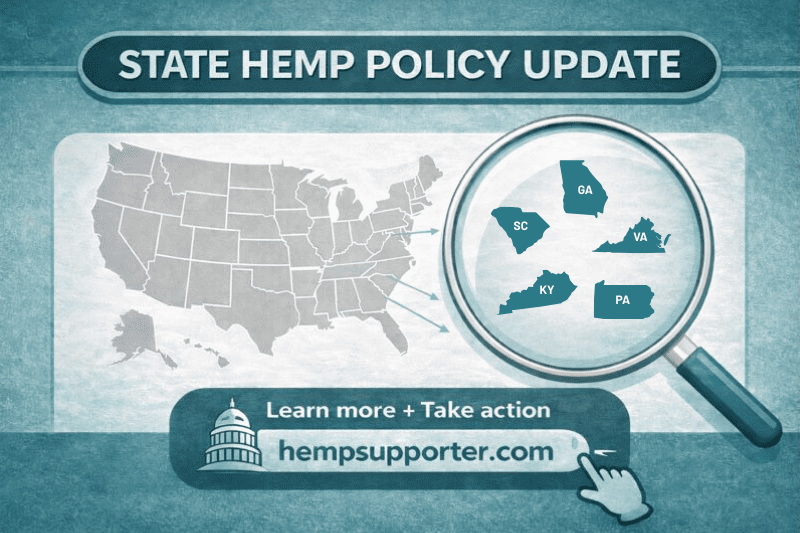
Take Action Now: Use our State Action Center to contact lawmakers and protect the future of hemp in your state.
As state lawmakers across the country are considering legislation affecting hemp-derived products. Below is a state-by-state summary of key bills we are supporting, opposing, or monitoring, along with opportunities to engage where action is needed. Be sure to check back next week for updates on these bills and others, and as always, please share any bills you are hearing about across the states that aren’t mentioned here.
Georgia
SB 33 (Oppose)
As we previously reported, Georgia lawmakers are considering SB 33, legislation that would adopt federal cannabinoid beverage language limiting THC content to 0.4 mg per container.
We are flagging this bill again because the situation is moving quickly and we need hemp supporters to continue making their voices heard. This extremely restrictive limit would effectively eliminate the lawful hemp beverage market in Georgia by setting potency levels far below what is commercially viable for regulated products.
Rather than creating a workable regulatory framework, this approach would remove legal options for consumers and severely disrupt hemp businesses operating in the state.
A committee meeting to discuss SB 33 is scheduled for tomorrow at 10:30 AM, making it critical that lawmakers hear from constituents immediately.
Georgia Residents – Take Action Now: Contact your lawmakers and urge them to oppose SB 33 and any effort to impose a 0.4 mg THC per container limit that would effectively eliminate Georgia’s hemp beverage market.
Kentucky
SB 223 (Support)
As we previously reported, Kentucky lawmakers are considering two different approaches to regulating hemp-derived products. We are flagging this issue again because continued engagement from hemp supporters will be critical as these bills move forward.
SB 223 would create lawful retail and distribution opportunities for cannabis-infused beverages by integrating these products into the state’s existing alcohol regulatory framework.
The bill:
- Authorizes supplemental licenses allowing qualified retailers — including hemp retail establishments — to sell cannabis-infused beverages
- Establishes a clear regulatory pathway under the Department of Alcoholic Beverage Control
- Prohibits open containers of THC beverages in motor vehicles, an important safeguard for responsible regulation
SB 223 represents a practical, workable approach that allows hemp businesses to operate in a licensed marketplace while ensuring appropriate oversight.
HB 9 (Formerly HB 612 — Support if Amended)
Meanwhile, legislation previously introduced as HB 612 has now been filed as HB 9, proposing a 1.6% tax structure on hemp-derived cannabinoid products. The proposal also reduces certain licensing fees, which is a step in the right direction.
However, HB 9 would benefit from several targeted amendments to ensure the framework is fair, workable, and properly tailored to the types of hemp products on the market today.
Specifically, improvements are needed to:
- Eliminate the double taxation of THC beverages at both the wholesale and retail levels
- Reduce the retailer license fee from $2,000 to $570 to align with alcohol retail licensing
- Exempt non-intoxicating hemp products, as determined by the Cabinet for Health and Family Services, from cannabinoid licensing fees and requirements
- Tax THC by the milligram rather than milliliter, ensuring a more accurate and equitable taxation structure
With these improvements, HB 9 could become a workable framework for Kentucky businesses and consumers while supporting responsible regulation of intoxicating cannabinoid products.
Kentucky Residents – Take Action: Contact your legislators and urge them to support SB 223 and improve HB 9 to create a fair, workable regulatory framework for hemp-derived products.
Pennsylvania
SB 49 (Oppose)
Pennsylvania lawmakers are considering SB 49, legislation that has recently been amended to incorporate new federal hemp standards adopted in late 2025.
The bill would establish a Pennsylvania Cannabis Control Board to oversee cannabis and hemp-derived products under a single regulatory structure. As amended, the legislation mirrors the updated federal definition of hemp, which significantly tightens the scope of lawful hemp products.
If implemented as described, these changes could effectively ban up to 95% of hemp-derived cannabinoid products.
While policymakers are seeking greater regulatory clarity, simply adopting a broad federal prohibition framework would eliminate large portions of the lawful hemp marketplace rather than establishing a workable regulatory system. Responsible regulation should instead focus on testing standards, labeling requirements, age restrictions, and enforcement against bad actors- policies that protect consumers while allowing responsible businesses to continue operating. SB 49 is currently under consideration in the Senate Law and Justice Committee, and we will continue monitoring developments closely.
Pennsylvania Residents – Take Action: Contact your state lawmakers and urge them to oppose SB 49 as amended and pursue responsible regulation of hemp-derived products rather than policies that effectively eliminate the existing marketplace.
South Carolina
H.3924 (Oppose as Written, Support Kimbrell Amendment)
As we have been reporting, we continue to monitor H.3924 in South Carolina and are flagging this issue again to encourage hemp supporters to remain engaged and continue contacting lawmakers.
As written, the bill would broadly prohibit hemp products capable of producing a “psychoactive reaction,” a sweeping definition that in practice bans nearly all hemp-derived edibles and other non-beverage consumable products.
Hemp beverages are a fast-growing and innovative segment of the market that has created new opportunities for retailers, distributors, and consumers. When properly regulated, beverages can coexist successfully alongside other hemp product forms.
However, H.3924 allows hemp beverages containing up to 10 mg THC per container while eliminating other product forms entirely, effectively dismantling much of South Carolina’s existing hemp retail sector.
The practical effect of H.3924 as written would be:
- A full ban on hemp-derived edibles and other non-beverage consumables
- Forced closure of an estimated 1,800 small, locally owned retail stores
- Loss of jobs across the state, including veteran-owned businesses
- Reduced consumer access to regulated, tested hemp products
Kimbrell Amendment (Support)
Senator Kimbrell has proposed an amendment that would allow hemp-derived consumable products to remain legal under a regulated framework rather than banning them outright.
This approach recognizes that if hemp beverages can be responsibly regulated at up to 10 mg THC per container, other product forms, such as edibles, can also be regulated using similar science-based standards, testing requirements, and age restrictions.
The Kimbrell amendment would help preserve South Carolina’s existing hemp marketplace while still providing policymakers with appropriate regulatory guardrails.
A blanket ban on edibles is not regulation- it is prohibition.
South Carolina Residents – Take Action: Contact your state lawmakers and urge them to oppose H.3924 as currently written and support the Kimbrell amendment to allow regulated hemp consumables.
Virginia
RED ALERT: Conference Amendment to SB 542 Threatens Virginia Hemp Industry
At the 11th hour of Virginia’s legislative session, language was added in conference committee that would dramatically alter the state’s hemp marketplace.
The provision would:
- Cap hemp products at 2 mg THC per package
- Eliminate the 25:1 CBD-to-THC ratio exception that has shaped Virginia’s hemp market for the past two years
If enacted as written, these changes would effectively eliminate Virginia’s hemp industry by July.
Notably, hemp product regulations were never debated during the legislative session, making this late-stage change entirely unexpected for businesses operating under the current framework. Some hemp retailers were even opening new stores as the legislative session was concluding with no anticipated changes.
The legislation is part of a broader recreational marijuana bill that would allow legal retail cannabis sales beginning in 2027. As written, the proposal would eliminate the hemp market nearly a year before regulated marijuana dispensaries open, creating a gap in consumer access to cannabinoid products while forcing small businesses to immediately liquidate inventory and close operations.
The Governor has until April 13 to sign or amend the bill. Hemp stakeholders across Virginia are currently evaluating options and discussing next steps with policymakers.
A key priority is establishing a transition period that would allow hemp products currently on the market — including those operating under the existing 25:1 ratio framework — to remain available until the regulated cannabis retail system launches. Aligning the effective date of hemp definition changes with the opening of marijuana dispensaries would provide businesses time to responsibly transition while maintaining consumer access to regulated products.
We will continue monitoring developments closely and will share updates as this situation evolves. In the meantime, Virginia residents – Take Action: Contact the Governor and urge her to amend.

Visit our State Action Center to see active campaigns across the country!
Check out the latest hemp and CBD updates from across the states!
- State Hemp Policy Update: Delaware, Illinois, Nebraska, Nevada, Pennsylvania (Philadelphia), and Virginia
 Take Action Now: Use our State Action Center to contact lawmakers and protect the future of hemp in your state. As state lawmakers across the country are considering legislation affecting hemp-derived products. …
 - State Hemp Policy Update: Delaware, Illinois, Michigan, and Ohio.
 Take Action Now: Use our State Action Center to contact lawmakers and protect the future of hemp in your state. As state lawmakers across the country are considering legislation affecting hemp-derived products. …
 - State Hemp Policy Update: Delaware, Illinois, Nebraska, New Jersey, Pennsylvania (Philadelphia), and Virginia
 Take Action Now: Use our State Action Center to contact lawmakers and protect the future of hemp in your state. We’re officially back with our state updates. for 2026. As state lawmakers …