INDUSTRY UPDATES
June 23, 2026
State Hemp Policy Update: Delaware, Illinois, Nebraska, Nevada, Pennsylvania (Philadelphia), and Virginia
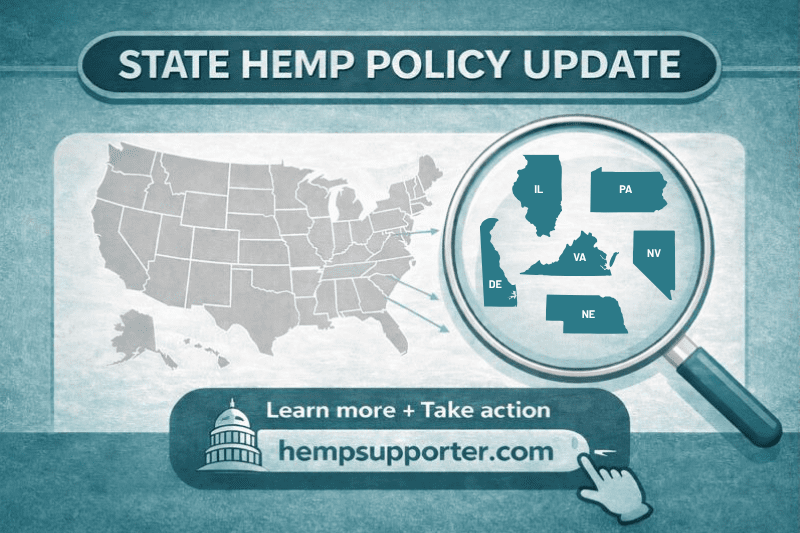
Take Action Now: Use our State Action Center to contact lawmakers and protect the future of hemp in your state.
As state lawmakers across the country are considering legislation affecting hemp-derived products. Below is a state-by-state summary of key bills we are supporting, opposing, or monitoring, along with opportunities to engage where action is needed. Be sure to check back next week for updates on these bills and others, and as always, please share any bills you are hearing about across the states that aren’t mentioned here.
Delaware
HB 373 / HB 395 (Oppose)
We’ve been keeping you updated on the latest here, and we need Delaware supporters to act AS SOON AS POSSIBLE. Unfortunately, both bad bills in Delaware passed the House last week and are headed to the Senate.
HB 373 would unnecessarily limit market access and harm existing businesses. The bill sets forth a new framework for THC-infused beverages, including manufacturing standards, authorization requirements, taxation, and restrictions on how and where those beverages may be sold.
While the bill allows beverages containing up to 10 milligrams of Delta-9 THC per container and includes reasonable product testing, labeling, and youth access safeguards, it restricts sales to package stores and marijuana retailers while imposing new taxes, licensing fees, and operational burdens on businesses. Delaware should not create a system that unnecessarily limits consumer access and shuts out broader retail participation.
HB 395 is a prohibition bill that would effectively classify many hemp-derived cannabinoid products as marijuana products by applying a 0.4 milligram total THC per container threshold.
The bill also specifies which cannabinoids are considered non-intoxicating and introduces the concept of “counterfeit THC ingredients,” defined as cannabinoids not naturally produced by the cannabis plant or those synthesized artificially, with restrictions on their inclusion in products intended for human or animal consumption. If enacted, the legislation would wipe out over 95% of the existing hemp marketplace in Delaware.
Delaware Residents: Take Action: Contact state Senators and urge them to vote NO on HB 373 and HB 395.
*The Delaware session is currently scheduled to adjourn on June 30th, 2026.
Illinois (Correction)
Illinois (Correction)
S 3222 (Oppose- Signed into Law)
As a correction to our reporting last week, which referenced earlier bill numbers, Illinois lawmakers officially passed SB 3222 as the final legislative vehicle for hemp restrictions. Governor JB Pritzker signed SB 3222 into law on June 12, 2026. This legislation, formerly tracked as HB 5784 / SB 20, creates the Illinois Hemp Act and officially repeals the existing Industrial Hemp Act on November 12, 2026.
The new law imposes a strict 0.4 milligram per container cap on total THC and other cannabinoids deemed to have similar effects to THC. It is critical to understand that this threshold is effectively ban language that would eliminate approximately 95% of products currently in the hemp marketplace. Products exceeding that threshold would no longer qualify as lawful hemp and instead could only be sold through licensed cannabis dispensaries under the Cannabis Regulation and Tax Act.
The legislation also excludes many existing hemp-derived cannabinoid products from the legal definition of hemp, creates extensive registration and compliance requirements for retailers and manufacturers, and establishes broad enforcement authority over the marketplace. The law immediately bans the sale of intoxicating hemp products to anyone under 21, while the full regulatory framework takes effect November 12, 2026, aligning with the effective date of the corresponding federal ban.
Notably, the legislative process drew significant industry opposition, with many businesses warning of economic harm. However, the bill passed both chambers and was signed without amendment to the THC threshold. The law does create a transition path for hemp businesses to enter the licensed cannabis market, with at least 45 infuser licenses reserved for social equity applicants beginning in January 2027.
*Illinois has a year-round session that is currently adjourned
Nebraska
Proposed Adulterated Food Product Regulations (Monitoring)
The Nebraska Department of Agriculture held a rulemaking hearing on June 18, 2026, regarding the previously reported proposed “Adulterated Food Product Regulations” under the Nebraska Pure Food Act. The proposed regulations would classify food products containing any amount of tetrahydrocannabinols as adulterated or misbranded, effectively imposing a zero-THC standard for food products marketed as gummies, drops, and beverages, including synthetic THC products intended to produce psychoactive effects similar to Delta-9 THC.
The hearing drew significant opposition. Over 490 written comments were submitted opposing the proposed regulations, while only three comments were submitted in support. Fifteen speakers testified during the hearing, with many calling on the Department to pursue a regulatory framework rather than an outright ban. Industry representatives emphasized the economic impact of the proposed rules, noting that Nebraska’s hemp businesses generate over $10 million in annual sales tax revenue and employ approximately 2,000 people statewide. Notably, the proposed Nebraska rule goes beyond the federal standard expected to take effect in November 2026, which bans synthetic THC products and limits total THC concentrations to 0.4 milligrams per container. It is important to note that the federal 0.4 milligram per container threshold is itself effectively ban language that would eliminate approximately 95% of the current hemp product marketplace. The Nebraska proposal goes even further, requiring zero THC in food products rather than aligning with that federal threshold.
The proposed regulations include a carve-out for the medical cannabis acts, meaning individuals with medical cannabis cards would not be affected. The Department of Agriculture will now review the submitted comments and determine whether changes are warranted. If no changes are made, the regulations will proceed to the attorney general and the governor for approval.
No action requested at this time. We will continue monitoring the proposed regulations as they move through the review and approval process and share details as we know more.
*The Nebraska session adjourned on April 17th, 2026.
Nevada
Interim Study on Hemp Regulation (Monitoring)
Although SB 356 failed during Nevada’s 2025 regular session, the state is pursuing hemp regulation through an interim study mandated by Assembly Bill 76 (2025). The Cannabis Advisory Commission (CAC) has established a Consumable Hemp Subcommittee to study the regulation of hemp-derived products, including enforcement gaps, testing and labeling requirements, and the potential for dispensary-only distribution of intoxicating hemp products under the Cannabis Compliance Board.
On June 16, 2026, the Joint Interim Standing Committee on the Judiciary received a progress update on this study. The CAC must submit its report and legislative recommendations by November 9, 2026, for transmittal to the 84th Session of the Nevada Legislature (2027).
No action requested at this time. We will continue monitoring the CAC’s study progress and share details as we know more.
*Nevada does not have a 2026 legislative session.
Pennsylvania (Philadelphia)
City Ordinance – Bill No. 260163 (Oppose)
In an update to our previous reporting, Philadelphia City Council passed Bill No. 260163 unanimously on June 5, 2026. The ordinance establishes a new regulatory framework governing “intoxicating substances,” including hemp-derived cannabinoid products and kratom products.
Most notably, the ordinance prohibits the sale of final hemp-derived cannabinoid products containing more than 0.4 milligrams per container of total tetrahydrocannabinols and similar-effect cannabinoids. As noted throughout this update, the 0.4 milligram per container standard is effectively ban language that would eliminate approximately 95% of all hemp products on the marketplace. The bill was amended before final passage to remove topical products from the ban and to create a framework for legal sales of certain products that gain FDA approval in the future. Despite significant opposition (more than 50 individuals testified during the public comment period) the Council moved forward unanimously.
Mayor Cherelle Parker is expected to sign the bill. The ordinance carries a November 12, 2026 effective date, meaning hemp products are not affected until that date.
Philadelphia residents can find their councilmembers here: Philadelphia City Council Member Directory
*Pennsylvania has a year-round session, though the Philadelphia ordinance is handled separately through local government.
Virginia
Cannabis Budget Bill Hemp Implications (Oppose)
In a significant development following Governor Abigail Spanberger’s May 19 veto of SB 542 / HB 642 that we recently reported, Virginia lawmakers passed budget legislation that includes cannabis and hemp-related provisions. The budget bill has been sent to the Governor.
While the legislation primarily establishes a regulated adult-use marijuana retail marketplace with sales beginning July 1, 2027, it contains provisions directly impacting the hemp industry.
Most notably, the bill eliminates Virginia’s current CBD-to-THC ratio pathway and redefines lawful hemp products as those containing no more than 2 mg of THC per package. As written, this change would effectively prohibit approximately 95% of hemp products currently sold in Virginia, including many non-intoxicating CBD products, and create an abrupt regulatory cliff for more than 1,500 hemp retailers and related businesses operating under the Commonwealth’s existing legal framework.
Reports indicate that the hemp definition changes currently have an August 15, 2026 effective date. That timing would force compliant hemp businesses into a state-level ban nearly three months before the scheduled federal hemp definition change on November 12, 2026, placing unnecessary burdens on Virginia businesses ahead of federal action. Virginia hemp products are already subject to important consumer protections, including lab testing, restrictions on synthetic cannabinoids, and child-resistant packaging.
The bill would also transfer oversight of hemp products from the Virginia Department of Agriculture and Consumer Services (VDACS) to the Virginia Cannabis Control Authority (VCCA)- the same body that will oversee the new adult-use cannabis market. This consolidation of regulatory authority could have significant implications for how hemp-derived cannabinoid products are regulated going forward.
Other key provisions of the broader cannabis deal include up to 350 retail marijuana stores statewide, a 6 percent excise tax increasing to 8 percent after two years, serving size caps of 10 mg THC per serving and 100 mg per package, and a $10 million licensing conversion fee for existing medical cannabis operators entering the adult-use market.
Virginia Residents: Take Action! Contact Governor Spanberger and urge her to delay the effective date of the hemp definition changes until at least November 12, 2026, when the federal hemp definition is scheduled to change.
*The Virginia session adjourned on March 14th, 2026 and reconvened on April 22, 2026.

Visit our State Action Center to see active campaigns across the country!
Check out the latest hemp and CBD updates from across the states!
- State Hemp Policy Update: Delaware, Illinois, Nebraska, Nevada, Pennsylvania (Philadelphia), and Virginia
 Take Action Now: Use our State Action Center to contact lawmakers and protect the future of hemp in your state. As state lawmakers across the country are considering legislation affecting hemp-derived products. …
 - State Hemp Policy Update: Delaware, Illinois, Michigan, and Ohio.Take Action Now: Use our State Action Center to contact lawmakers and protect the future of hemp in your state. As state lawmakers across the country are considering legislation affecting hemp-derived products. …
- State Hemp Policy Update: Delaware, Illinois, Nebraska, New Jersey, Pennsylvania (Philadelphia), and VirginiaTake Action Now: Use our State Action Center to contact lawmakers and protect the future of hemp in your state. We’re officially back with our state updates. for 2026. As state lawmakers …