INDUSTRY UPDATES
March 03, 2026
State Hemp Policy Update: Alabama, Connecticut, Kentucky, Louisiana, Oklahoma, Rhode Island, South Carolina
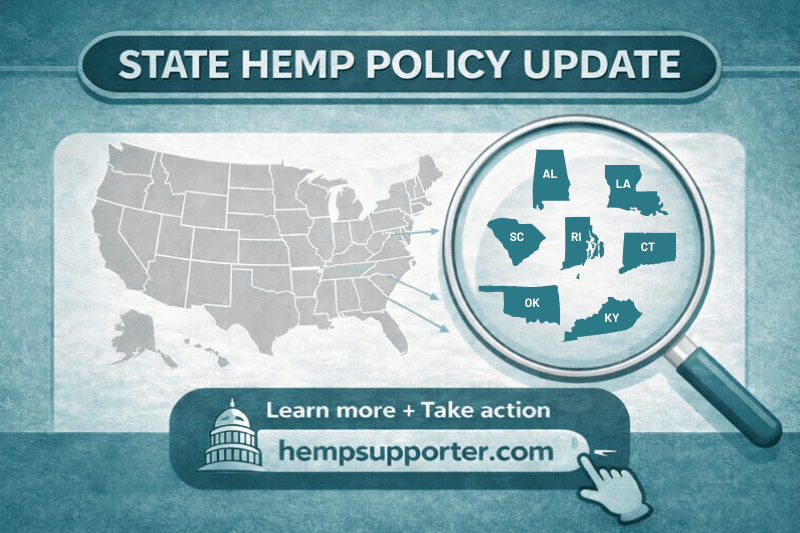
Take Action Now: Use our State Action Center to contact lawmakers and protect the future of hemp in your state.
We’re officially back with our state updates. for 2026. As state lawmakers across the country are considering legislation affecting hemp-derived products. Below is a state-by-state summary of key bills we are supporting, opposing, or monitoring, along with opportunities to engage where action is needed. Be sure to check back next week for updates on these bills and others, and as always, please share any bills you are hearing about across the states that aren’t mentioned here.
Alabama
SB321 (Oppose)
Like SB 1, which we previously reported on, SB 321 would effectively eliminate an estimated 95% of Alabama’s hemp product market by classifying hemp-derived psychoactive cannabinoids, including Delta-8, Delta-9, and Delta-10 THC, as Schedule I controlled substances and repealing the existing 21+ regulated sales framework.
Introduced on 2/24/26, the bill would remove the current statutory exemption for THC found in hemp and instead limit the exemption to non-psychoactive cannabinoids only. Although existing law lists THC as a Schedule I substance while broadly exempting THC derived from hemp, SB 321 narrows that exemption and explicitly treats hemp-derived psychoactive cannabinoids as controlled substances, regardless of source.
In addition, the bill repeals the provisions that currently allow certain consumable hemp products containing psychoactive cannabinoids to be sold to individuals 21 and older subject to testing, labeling, and retail restrictions — replacing a regulated marketplace with prohibition.
Alabama Residents – Take Action: Contact your lawmakers and urge them to oppose SB 321 and SB 1.
Connecticut
HB 5350 (Monitoring)
HB 5350 This legislation restructures the state’s cannabis and hemp framework by redefining “cannabis” to include high-THC hemp products while expressly excluding compliant hemp (≤ 0.3% total THC), infused beverages, and certain qualifying commercial extracts.
The bill increases THC limits for infused beverages to 5 mg per container in liquor-licensed channels and 10 mg per container at cannabis retailers, establishes a definition for high-THC beverages, and restricts those higher-potency beverages to out-of-state sales. It also creates a comprehensive regulatory structure for infused beverages, including licensing, testing, labeling, distribution channel requirements, age verification, fees, and on-premises consumption endorsements.
No action requested at this time. We will continue monitoring.
Kentucky
SB 223 (Support)
We’ve been monitoring Kentucky legislative developments closely, and SB 223 will likely be heard in committee next week. If you live in Kentucky, we need you to contact your lawmakers and urge support for this bill.
As a refresher, SB 223 would create lawful retail and distribution opportunities for cannabis-infused beverages by integrating these products into the state’s existing alcohol regulatory framework. The bill authorizes supplemental licenses allowing qualified retailers, including hemp retail establishments, to sell cannabis-infused beverages and establishes a clear, workable regulatory pathway under the Department of Alcoholic Beverage Control.
This stands in contrast to HB 612, which we previously alerted you to. As written, HB 612 would impose a potency-based tax of $0.16 per milligram of THC on hemp-derived cannabinoid products beginning July 1, 2027. At this rate, the tax would dramatically increase consumer costs and function as a prohibition-level tax on compliant hemp products. The bill also establishes new licensing fees, enforcement penalties, and liability provisions that would significantly increase the regulatory burden on hemp retailers and restrict market participation.
Together, these bills represent two very different approaches. SB 223 creates a lawful and sustainable regulatory pathway that allows hemp businesses to participate in a licensed marketplace, while HB 612, unless amended, would impose excessive taxation that threatens the viability of Kentucky’s hemp industry.
Kentucky Residents – Take Action: Urge Kentucky lawmakers to support SB 223 and oppose SB 612.
Louisiana
HB539 (Support)
HB 539 authorizes bars and restaurants to sell consumable hemp products, including hemp beverages. It does not modify THC limits or create new product regulations.
Louisiana Residents – Take Action: Urge Louisiana lawmakers to support HR 539.
Oklahoma
HB 4248 (Support)
HB 4248 sets age limits to 21 and up for hemp beverages.
Oklahoma Residents – Take Action: Urge Oklahoma lawmakers to support HB 4248.
Rhode Island
HB7856 (Monitoring)
HB 7856 centralizes cannabis regulatory authority and expands commission oversight, leaving specific THC potency limits to future rulemaking rather than statute. The measure mandates child-resistant packaging and comprehensive product testing, including accurate THC labeling and contaminant screening standards. It also reinforces age-based access controls by requiring procedures to prevent sales to individuals under 21.
Notably, the bill imposes a broad prohibition on cannabis advertising in any medium that may be visible to minors- a provision that could significantly limit lawful marketing and promotional activity.
If this bill passes, we will monitoring rulemaking developments closely, particularly with respect to future potency caps and advertising restrictions.
No action requested at this time. We will continue monitoring.
South Carolina
H. 3924 (Oppose)
We have been motinoring South Carolina closely this session, and now our focus has shifted to H. 3924.
This bill would broadly prohibit hemp products capable of producing a “psychoactive reaction,” a sweeping definition that in practice bans nearly all hemp-derived edibles and non-beverage consumable products.
Hemp beverages are a fast-growing, innovative segment of the market and have created new opportunities for retailers, distributors, and consumers. When properly regulated, they can coexist successfully alongside other hemp product forms.
However, while the bill allows hemp beverages containing up to 10 mg THC per container, it eliminates other product forms entirely, effectively dismantling much of South Carolina’s existing hemp retail sector.
The practical effect of H.3924 would be:
- A full ban on hemp-derived edibles and other non-beverage consumables
- Forced closure of an estimated 1,800 small, locally owned retail stores
- Loss of jobs across the state, including veteran-owned businesses
- Reduced consumer access to regulated, tested products
If hemp beverages can be regulated responsibly at up to 10 mg THC per container, then other consumable product forms can be regulated under similar, science-based standards. A blanket ban on edibles is not regulation — it is prohibition.
South Carolina residents – Take Action: Contact state lawmakers and urge them to oppose H.3924.

Visit our State Action Center to see active campaigns across the country!
Check out the latest hemp and CBD updates from across the states!
- State Hemp Policy Update: Georgia, Kentucky, Pennsylvania, South Carolina, Virginia
 Take Action Now: Use our State Action Center to contact lawmakers and protect the future of hemp in your state. As state lawmakers across the country are considering legislation affecting hemp-derived products. …
 - State Hemp Policy Update: Alabama, Connecticut, Kentucky, Louisiana, Oklahoma, Rhode Island, South CarolinaTake Action Now: Use our State Action Center to contact lawmakers and protect the future of hemp in your state. We’re officially back with our state updates. for 2026. As state lawmakers …
- State Hemp Policy Update: Georgia, Indiana, Kentucky, Michigan, Minnesota, Missouri, New Hampshire, Ohio, New Jersey, New York, Virginia, and WashingtonTake Action Now: Use our State Action Center to contact lawmakers and protect the future of hemp in your state. We’re officially back with our state updates. for 2026. As state lawmakers …